The overview · start here
AI Visibility, Explained: How to Audit, Correct, and Engineer What AI Says About You
When a buyer asks an AI assistant about your category, an answer gets written, with or without you in it. This is how to find out what it says, and how to change it.
The problem
There's an answer about you you've never read
More buyers now begin their research by asking an AI assistant — "what's the best tool for X?", "is product Y any good?", "what should I use instead of Z?" — and the assistant writes back a confident answer. That answer names some companies, describes them, and quietly leaves others out. The scale is no longer niche: ChatGPT alone reported around 900 million weekly active users by early 2026, up from 400 million a year earlier (OpenAI, via TechCrunch) — these assistants are now a default first stop for answers.
You have probably never read the answer that gets written about you. You can't see it in your analytics, and there is no notification when an assistant describes your product wrongly or omits it from a shortlist. The decision happens, and you're not in the room.
This is a different problem from ranking on a search results page. A search engine hands the buyer ten links and lets them choose. An AI assistant hands them a conclusion. If that conclusion is wrong about you — or simply doesn't mention you — there's often no second link to click, and even when sources are shown, the conclusion is what sticks.
Why it's its own discipline
Not SEO with a new label
The work of being described well by AI goes by two names, used more or less interchangeably: Answer Engine Optimization (AEO) and Generative Engine Optimization (GEO). The umbrella term I prefer, because it's the clearest, is AI visibility.
It isn't search engine optimization with a new label. SEO asks "do we rank for this keyword?" AI visibility asks three different questions: recognition — does the model know you exist, as the right kind of entity? accuracy — when it describes you, is what it says true? and citation — when it answers, whose sources is it drawing on, yours or someone else's account of you?
A page can rank well on Google and still be invisible, misdescribed, or uncited inside an AI answer. Different surface, different rules. (For plain definitions of these terms, see AI visibility & ACE, defined.)
The method
ACE: Audit, Correct, Engineer — then Measure and Monitor
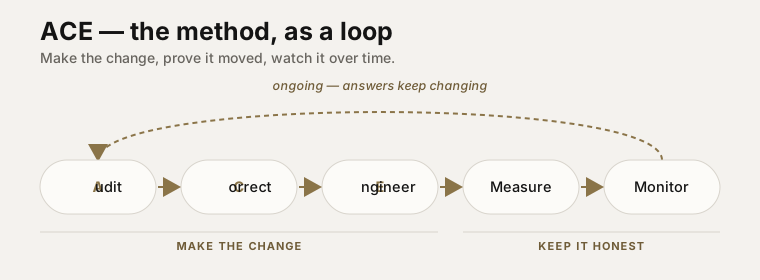
I work this problem with a method I call ACE — Audit, Correct, Engineer — followed by two stages that keep it honest over time, Measure and Monitor.
Audit. Before changing anything, find out what the answer actually says today. Ask the questions a real buyer would ask, across the major assistants, and record what each one says: whether you're named, whether the description is accurate, who gets cited, and who shows up instead of you.
Correct. Most visibility problems are narrative problems. The model describes you using whatever it found — often a third-party summary that's outdated or thin. Correcting means making the true, clear account of what you do the easiest one for a model to find and repeat.
Engineer. Some of the work is technical: making your information machine-readable so an assistant can parse it without guessing — clean structured data, an unambiguous identity, content shaped so the right facts are easy to extract.
Measure. A fix only counts if it moves the answer. Re-run the same audit against the same baseline and see what changed. This is the step that separates a real method from a promise.
Monitor. AI answers are not fixed. They shift as models update, as the web changes, as competitors act. Monitoring is the ongoing watch: catching drift, new errors, and new gaps as they appear.
What an audit scores
The seven dimensions
A useful audit scores specific things, not a single number. Four describe the answer the buyer sees: whether you're recognized, whether the description is accurate, how you're framed against competitors, and whether you're recommended. The last of these — recommendation — is the one everyone wants to move directly, and the one you can't: it's an outcome, a result of the others.
Three describe the machinery underneath: how clearly your own material explains you, whether your structured data is valid and readable, and whether reputable sources cite you. These are the levers you can actually pull.
The machinery · what a company can change
The outcome · what the engines say
Why it's measured
Measurement is the point
A number with no method behind it tells you nothing. If you can't re-run it, you can't know whether anything you did worked. So the version of this worth doing is reproducible — the same questions, the same conditions, run again — and human-verified, where a person stands behind each call rather than trusting an automated grade.
Try it yourself
What you can do today
- Ask the way a buyer would. In ChatGPT, Perplexity, and Google's AI mode — each in a fresh chat, with web search on — ask the questions a real buyer types: a few unbranded ("best [category] for [use case]"), a couple of comparisons ("[you] vs [competitor]"), and one or two direct ("what is [you]?"). Never say who you are; you want the answer a stranger gets.
- Record four things per answer. In a simple table: were you named, and how prominently? Was the description accurate? Who was cited? Who appeared instead of you? Patterns show up inside a dozen queries.
- Check your machinery. Does your site state plainly, in real text, what you do — and does it carry valid Organization structured data (JSON-LD)? Paste a page into a schema validator; if it doesn't parse, a model is guessing about you.
- Re-run in a month. Ask the identical questions again. Movement against that baseline — not a one-time score — is the only proof a change worked.
For the full walkthrough, see Audit your AI visibility in an afternoon — the same method, step by step, with the questions to ask and how to read what you find.
Close
The method is open; the work is in the doing
AI is now describing your product to people who never reach your website. The answer it gives is not fixed, and it's not out of your hands — but you can't change what you haven't measured.
This is the overview. Begin the course → Week 1: How AI Answers Are Actually Built.